Abstract
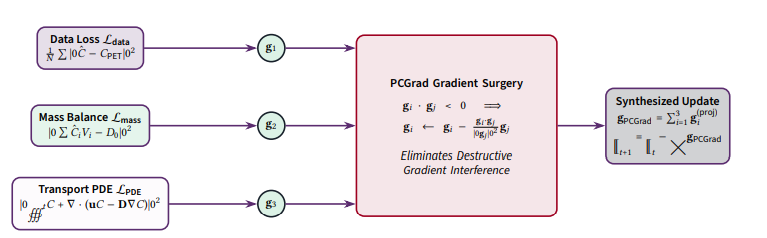
Targeted therapeutic pharmaceuticals, cytotoxic chemotherapies, and diagnostic radiotracers operate within complex vascular networks and tissue parenchyma governed by continuous advection-diffusion-reaction mass transfer. While numerical computational fluid dynamics (CFD) and classical physiologically based pharmacokinetic (PBPK) models simulate these biochemical transport cascades, they face severe operational limitations: traditional grid-based solvers incur prohibitive computational latency, whereas reducedorder compartmental formulations collapse complex intra-organ spatial variations into over-simplified homogeneous pools. In this study, we propose a physics-constrained neural operator framework that directly learns continuous solution operators for multi-scale advection-diffusion-reaction partial differential equations across heterogeneous patient-specific anatomical geometries. Combining Fourier Neural Operators (FNO) with deep branch-trunk operator networks, our architecture maps initial vascular inflows and complex organ boundaries directly to continuous four-dimensional spatio-temporal concentration and radiation absorbed dose fields. To guarantee biological and physical fidelity, we embed strict conservation-of-mass constraints directly into the operator loss landscape via Helmholtz-Hodge divergence-free flow projections and composite physics-informed residual penalties that enforce global mass balance (∑︁ CiVi = D0). Evaluated across synthetic multi-scale hemodynamic channels and voxelized clinical datasets of patients undergoing [177Lu]-DOTATATE peptide receptor radionuclide therapy, the proposed physics-constrained operator achieves a 73.2% reduction in spatio-temporal concentration prediction error compared to conventional physics-informed neural networks (PINNs) while executing three orders of magnitude faster than high-resolution finite element simulations (14.6 ms vs 82.4 min). Decisively, our hard-constrained mass projection completely eliminates unphysical mass creation and destruction, restricting cumulative mass drift to less than 0.04% over 96 hours of simulated biological transport. Furthermore, the learned neural operator exhibits zero-shot mesh invariance, evaluating solution fields across arbitrary grid resolutions without retraining. These results establish physics-constrained neural operators as an ultra-fast, mathematically rigorous foundation for real-time patient-specific radiation dosimetry, oncological treatment planning, and precision drug delivery optimization.