Abstract
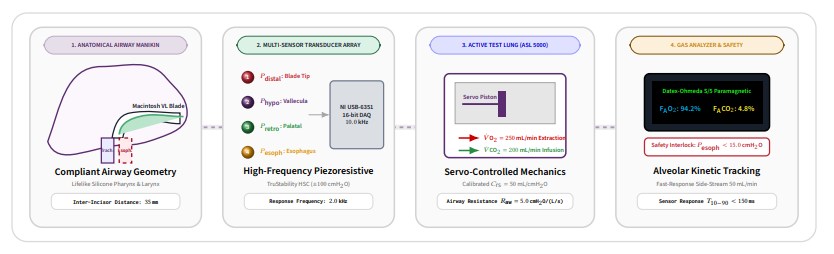
Video laryngoscopy has markedly enhanced glottic visualization during emergency tracheal intubation; however, lens obscuration by biofluids remains a primary cause of procedural delay, failed first-pass attempts, and secondary hypoxemic cardiac arrest. Dual-function video laryngoscope (VL) blade architectures integrate an internal oxygen conduit that simultaneously discharges a high-velocity micro-gas jet to aerodynamically clear the camera lens while delivering continuous apneic oxygenation toward the glottic aperture. While benchtop optical studies confirm rapid lens decontamination, the physiological safety of delivering high-velocity gas jets directly into the human pharynx has not been empirically verified. In particular, the critical physiological safety hypothesis—stipulating that distal pharyngeal nozzle pressures remain strictly beneath the lower esophageal sphincter (LES) opening threshold (10 to 15 cmH2O) to prevent catastrophic gastric insufflation and pulmonary barotrauma—demands rigorous experimental evaluation. In this investigation, we inserted prototype oxygenating VL blades into an anatomically compliant airway manikin connected to an active dual-chamber servo-controlled test lung (IngMar ASL 5000). Highfrequency piezoresistive pressure transducers positioned at the distal nozzle exit, retro-palatal pharynx, hypopharynx, and mid-esophagus captured microsecond pressure transients during continuous (5, 10, and 15 L/min) and high-speed solenoid-actuated burst (100 ms to 500 ms) oxygen delivery. Concurrently, test-lung alveolar oxygen fraction (FAO2) was recorded over 180 seconds of simulated clinical apnea and compared against conventional high-flow nasal cannula (HFNC) apneic oxygenation (15 L/min) and nooxygenation controls across 120 randomized experimental trials. Across all tested delivery regimes, peak distal pharyngeal pressure remained exceptionally low (2.84 ± 0.22 cmH2O at 10 L/min continuous flow, and 4.18±0.35 cmH2O under aggressive 15 L/min bursts), providing a greater than two-fold safety margin below the most conservative esophageal opening threshold (10 cmH2O) and generating zero detectable esophageal pressure transmission (????esoph < 0.2 cmH2O). During 180 seconds of apnea, the dual-function blade sustained a test-lung FAO2 of 0.892 ± 0.018 at 10 L/min and 0.934 ± 0.012 at 15 L/min, significantly outperforming standard nasal cannula oxygenation (FAO2 = 0.584 ± 0.026, ???? < 0.0001) and completely averting the severe desaturation observed in control trials (FAO2 = 0.211 ± 0.015). These empirical findings definitively confirm the physiological safety of the integrated gas-jet architecture, establishing that high-velocity pneumatic lens clearance and profound apneic oxygenation can be delivered simultaneously without inducing gastric insufflation or pulmonary barotrauma.